
Blog
Men’s Wedding Hospitality in Kuwait: Qahwaji and Coffee Servers for the Guests’ Reception

In short: a men’s wedding in Kuwait is an evening of receiving well-wishers rather than a long seated party. Guests arrive in waves, greet the groom and his family, drink a cup of Arabic coffee, sit for a short while and leave. Men’s wedding hospitality therefore needs qahwaji and coffee servers who keep moving between the rows, not a fixed corner: one qahwaji or server for every 25 to 30 guests at peak time, Arabic coffee that never runs out, cold water and tea, dates at the entrance, and a team that arrives an hour before the first guest.
How does the reception of well-wishers work at a men’s wedding?
The rhythm of a men’s wedding is different from the ladies’ celebration. The groom, his father, brothers and uncles stand in a receiving line at the entrance, and well-wishers come in successive waves for two or three hours, most staying between ten minutes and half an hour. In that short time the first cup of coffee has to reach the guest within a minute or two of sitting down, coffee is offered again to those who want it, and water or tea follows for anyone staying longer. Any delay in the first cup is noticed immediately, because it is the heart of the welcome in a Kuwaiti majlis.
What is served at a men’s wedding?
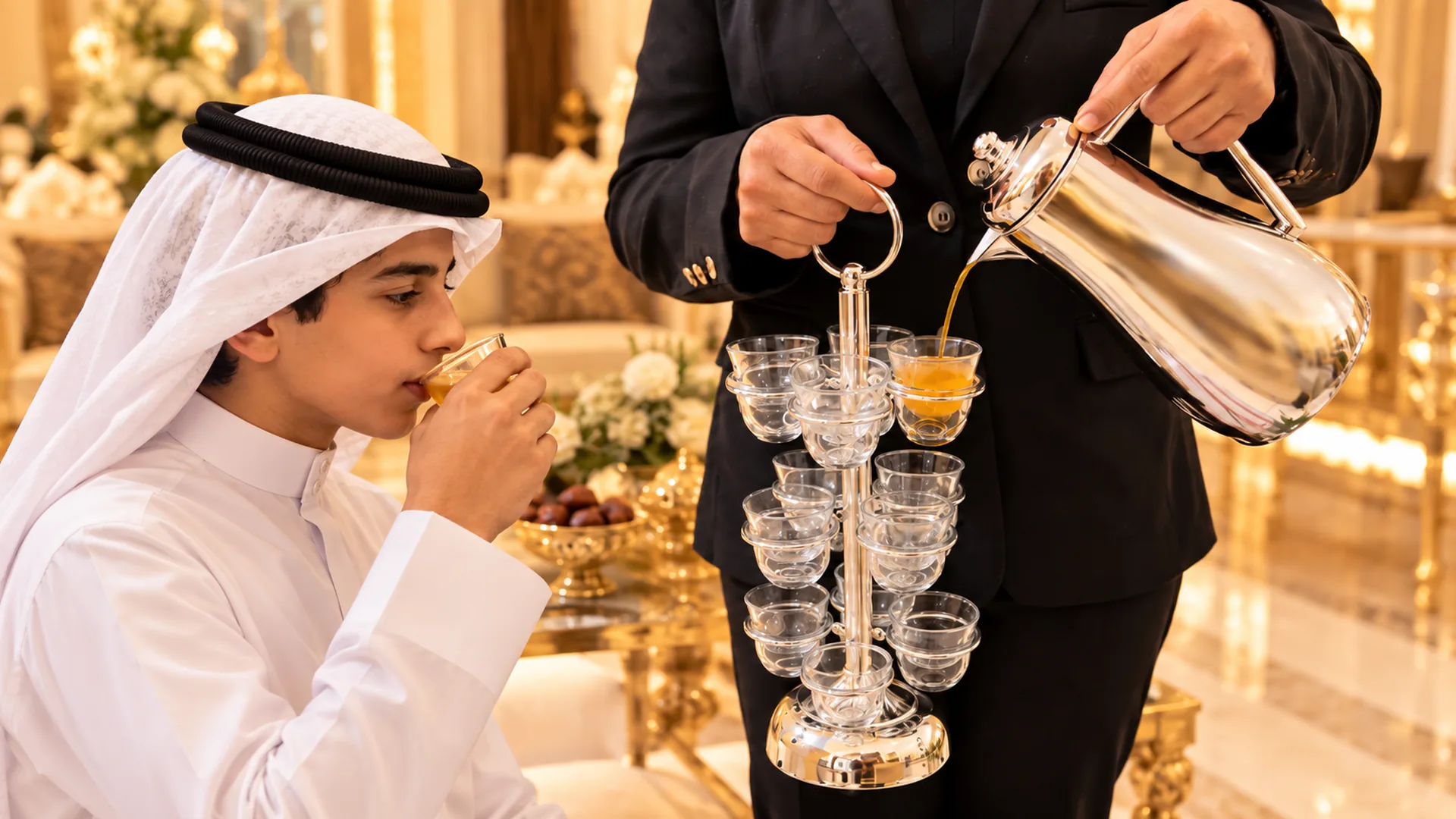
- Arabic coffee: the foundation of the hospitality, poured from the dallah into small cups, with cardamom and saffron to the family’s taste, and refilled from large flasks all evening. Read more about our Arabic coffee service for events.
- Cold water: served with the coffee or straight after it, and kept available at every seating group.
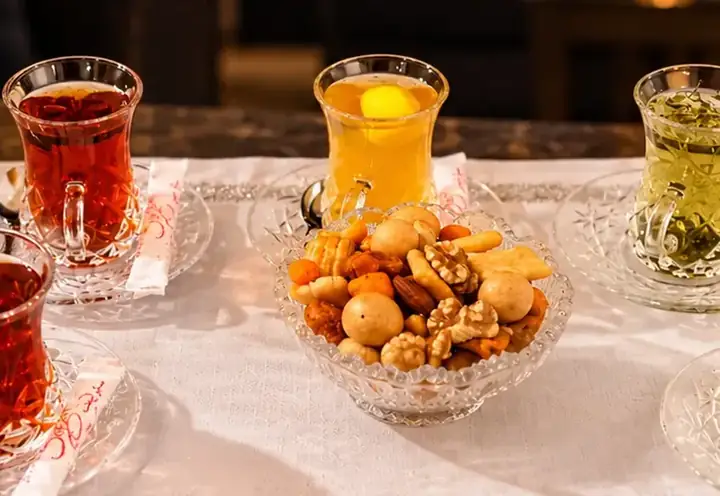
- Tea: for guests who stay longer, such as elders and the groom’s relatives, served in glass cups on trays.
- Dates: at the entrance or with the coffee, in simple bowls refreshed through the evening.
- In winter: karak tea or sahlab can be added for weddings held in tents and open diwaniyas.
- Fresh juices: an optional extra for summer weddings or when many young guests are expected, served after the coffee, never before it.
Dinner and its service are a separate matter from the drinks hospitality. The role of the qahwaji and servers is to keep the majlis supplied with coffee, water and tea from the first well-wisher to the last guest to leave, even while the family is busy with greetings and photos.
How many qahwaji and servers does a men’s wedding need?
Because well-wishers keep rotating through the seats, the number is based on peak attendance in a single hour, not on the total guest list. The rule we work with:
- Up to 100 guests at peak: 3 to 4 qahwaji and servers, one of them at the entrance.
- 100 to 200 guests: 5 to 7, with the majlis divided into sections, one server per section.
- 200 to 400 guests: 8 to 12 with a hospitality supervisor who manages the flow and watches the flasks and water.
- More than 400: the number is set after a site visit, usually with an extra qahwaji at every entrance.
- Two majlis areas (a diwaniya and a tent, for example): each is counted as a separate wedding.
Full staffing numbers for every occasion are in our guide how many hostesses do you need.
Diwaniya, wedding hall or a tent at home?
In a diwaniya the seating runs along the sides of the room and movement is easy, but the kitchen is often small, so the qahwaji need spare flasks ready before the reception starts. In a wedding hall the space is large and the seats are many; what matters most is agreeing with the hall management on the team’s arrival time, where the coffee is prepared and the walkways. In a tent in front of the house, where many Kuwaiti weddings are held especially in winter, you need a preparation point protected from dust, enough lighting and extra staff because guests spread over a wider area. See our diwaniya hospitality page for what makes majlis service different.
The wedding evening from the team’s arrival to departure
- One hour before the reception: the team arrives in a smart matching uniform, sets up the dallahs, flasks, cups and water, and checks the seating and entrances.
- Half an hour before: dates and coffee ready at the entrance, and every server assigned to a section.
- The first hour: usually the peak; the focus is the first cup within two minutes of a guest sitting down.
- Mid-evening: flasks and water refreshed, and a round of tea for those still seated.
- When the groom enters or the zaffa begins: serving pauses and the team stays out of the photographers’ path.
- After the last well-wisher: cups and equipment are collected and the place is tidied quietly before the family leaves.
Mistakes that spoil men’s wedding hospitality
- Counting qahwaji on the total guest list instead of the peak hour, so the team is too large at the start and too small during the rush.
- Too few flasks with a distant kitchen, so coffee runs out at the height of the reception.
- No server assigned to the entrance, where elders and guests arriving from far away stand.
- Serving juice before the coffee; in a Kuwaiti majlis hospitality begins with the cup.
- Agreeing the team’s arrival time with the hall too late, so setting up happens while guests are arriving.
- Forgetting the morning or second-day reception where there is one; it needs a smaller but well-organised team.
Frequently asked questions
When should I book men’s wedding hospitality?
At least two weeks before the wedding, and a month ahead in wedding season and Eid holidays. See our wedding hospitality booking timeline for what to settle at each stage.
Can you cover the men’s wedding and the ladies’ party on the same night?
Yes. We provide qahwaji and servers for the men’s majlis and hostesses for the ladies’ hall at the same time, with a supervisor on each side, even when the two venues are at different addresses.
Do you bring the equipment?
Yes. Dallahs, flasks, cups, tea glasses, trays and water all come with our team; we only need a preparation area with water and electricity in the diwaniya or hall.
Men’s wedding hospitality with Marasim Diyafa
Through our wedding hospitality and men’s hospitality services we provide qahwaji and servers in a matching uniform with full equipment in diwaniyas, halls and home tents across all governorates of Kuwait. Send us the wedding date, venue and expected number of guests on WhatsApp and we will reply with a written quote.